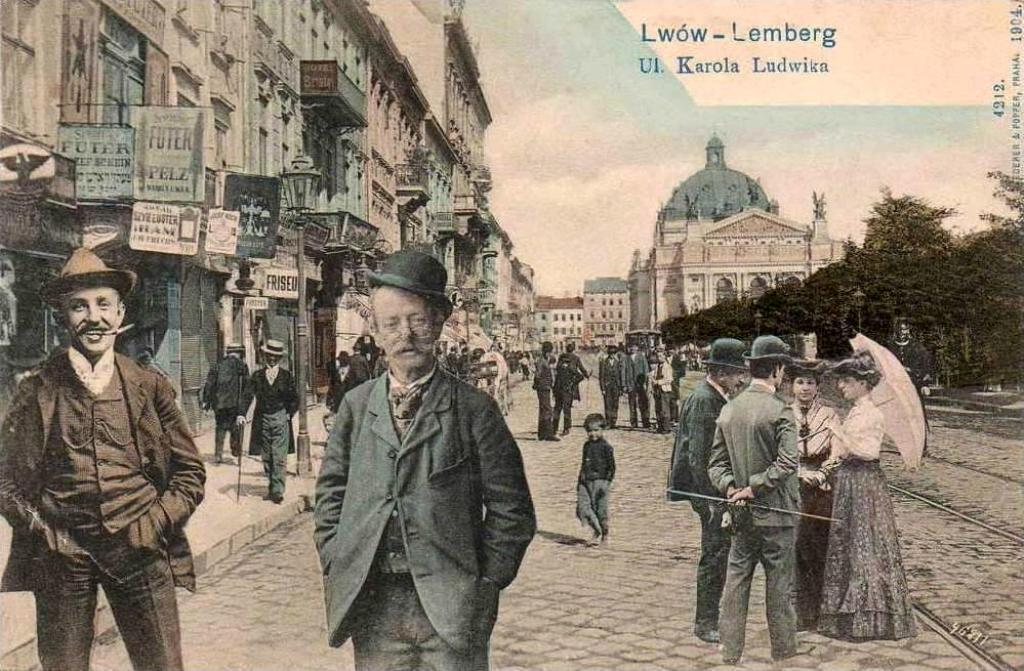
Before the age of radio, recorded music, or broadcast entertainment, the street song was among the most vital forms of urban musical life. In the courtyards, taverns, and dance gardens of nineteenth- and early twentieth-century cities, popular melodies passed from voice to voice, carrying the humor, sentiment, and identity of a neighborhood. Known across its history as Lemberg, Lwów, and Lviv — the multicultural capital of Galicia — this city developed one of the most distinctive urban song traditions in the Polish-speaking world, rivaled perhaps only by Warsaw. Sung in the characteristic local dialect known as bałak, these songs were the everyday musical culture of the city’s working population: people who did not attend the opera or the philharmonic, but for whom music was nonetheless a constant presence in daily life.
It encompassed drinking and tavern songs rooted in older Galician urban life; comic and celebratory songs tied to neighborhood festivities, local fairs, and calendar celebrations particular to Lwów; and patriotic songs honoring the city and the soldiers who defended it. Most celebrated of all were the songs of the batyar (aka andrus) — the street-wise, irreverent, proudly local figure rooted in the working-class neighborhoods, who became the defining emblem of Lwów’s popular culture from the early twentieth century onward.
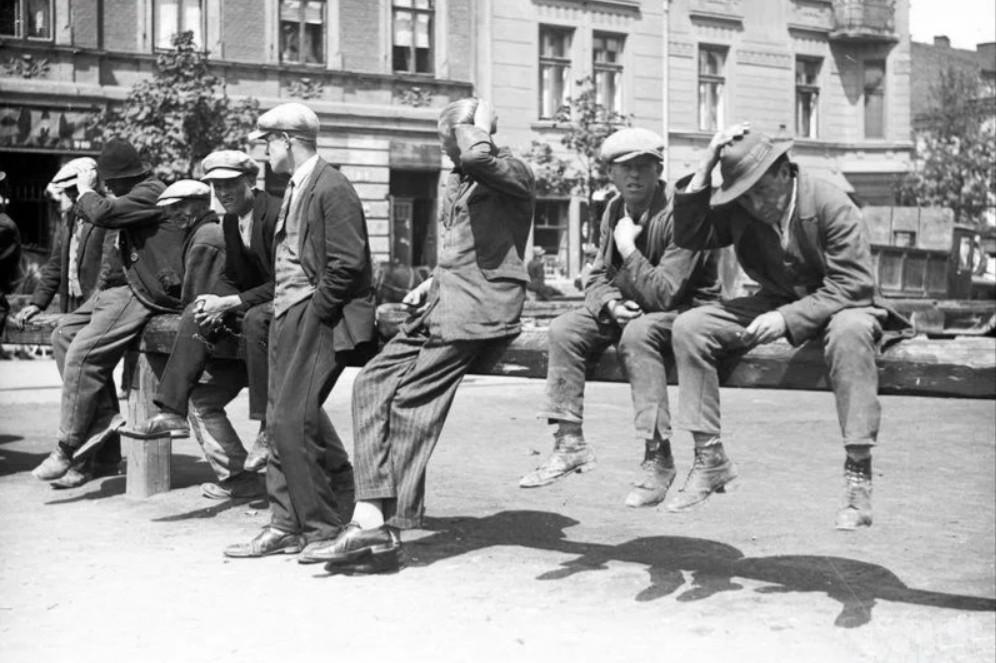
From these informal settings the tradition gradually reached wider audiences — first through the Lwów cabarets, then through the popular interwar radio program Na Wesołej Lwowskiej Fali (On the Merry Lwów Wave), which carried the songs well beyond Galicia. Titles such as “Bal u weteranów,” “W Stryjskim Parku na festynie,” or “Ballada o pannie Franciszce” became known across the country, and the batyar acquired a place in the broader Polish cultural imagination. Preserving these songs in performed, sung form is therefore not merely a local act of memory, but the documentation of a fragment of national culture.
Street Songs and Composed Songs
The repertoire associated with old Lwów includes both anonymous street songs and songs by known composers and lyricists. The boundary between the two was often fluid: professional musicians drew on the city’s dialect, humor, and popular musical idioms, while successful composed songs were readily absorbed into everyday urban culture.
The best-known example is Tylko we Lwowie (1939), composed by Henryk Wars with lyrics by Emanuel Schlechter for the film Włóczęgi. Popularized throughout Poland, it became one of the enduring musical symbols of the city. Alongside such composed works, however, there survived a large body of anonymous songs whose origins are no longer known. Together these two strands formed the musical soundscape of prewar Lwów and remain central to its cultural memory.
A Tradition at Risk of Being Forgotten
The displacement of Lwów’s Polish population after 1945, and the subsequent political constraints of the communist era, left this song tradition largely without a living community to sustain it. The most important scholarly effort to preserve it was the collection Lwów Street, Cabaret, and Occasional Songs until 1939, compiled by Jerzy Habela and Zofia Kurzowa and published by PWM in the 1980s. Containing approximately 150 songs with lyrics, musical notation, dialect glossary, and historical commentary, it remains the foundational reference for this repertoire. Yet a written collection, however thorough, cannot fully preserve a living song tradition. The songs of Lwów depend on oral performance — on the characteristic inflections of the dialect, on the phrasing of an accordion or guitar, on the particular energy of a sung gathering.
***
The Recording Project and the Zawilski Brothers
To preserve this fading oral tradition, Andrzej Kuntsman, Kazimierz Wiech, and Roman Waszczyszyn — Kraków-based friends with longstanding ties to Lwów and its culture — initiated a project to record these songs as they were traditionally sung and performed. For the recordings, they enlisted the brothers Zdzisław and Zenon Zawilski, who proved to be ideal performers for the task. Zdzisław (Zdzich) had spent years collecting and learning the Lwów repertoire, using the Habela–Kurzowa collection to verify texts and refine his command of the bałak dialect; he plays guitar and accordion. His brother Zenon plays violin. Their background — years of playing at traditional local celebrations — gives their performances a directness and authenticity that is difficult to replicate in more formal settings. The recordings were made at INIGO Studio in Kraków.
The Cassettes
Performers: Zdzisław Zawilski (guitar, accordion, vocals) and Zenon Zawilski (violin)
Producers: Andrzej Kunstman, Kazimierz Wiech, Roman Waszczyszyn
Recording studio: INIGO Studio, Kraków.
Purpose: Non-commercial documentation. Cassettes were distributed among enthusiasts at cost price, with printed lyric sheets included to provide full textual records.
Between 1999 and 2002, four cassettes were produced, collectively preserving 63 songs:
- Moje serce zostało we Lwowie (1999 · 17 songs)
- W Stryjskim Parku na festynie (2000 · 21 songs)
- Bal u weteranów (2002 · 12 songs)
- Tylko we Lwowie (2002 · 13 songs)
The repertoire spans prewar street songs from the Austrian period through the interwar Polish decades, the songs of the city’s batyar subculture, and later songs of exile and longing — covering, in other words, the full arc of Polish Lwów’s urban musical life. Together, the recordings represent a sustained attempt to document, in performed and sung form, a fragment of that culture which would otherwise survive only on paper.
Note: The batyar tradition has also found a separate contemporary voice in today's Lviv, where Ukrainian musicians — most notably Viktor Morozov, working with Batyar-Band Halychyna — have developed their own revival of the city's prewar urban song heritage. This Ukrainian neo-batyar repertoire, sung in a dialect mixing Ukrainian with traces of the old multilingual Lwów / Lviv vernacular, is a distinct but related phenomenon, reflecting the complex, shared history of the city and its musical life.
***
The Recordings
The recordings below represent a selection from the four cassettes produced between 1999 and 2002.
“Plac Muzyka” (Music Square)
This song dates from the first decade of the twentieth century. It celebrates the music of bands—primarily military ensembles—marching through the streets of Lwów.
“Sensacja trwa bo kino gra” (The Thrill Goes On as the Cinema Plays)
A street and cabaret song from 1911–1913 celebrating Lwów’s first movie theaters.
“Tam na rogu na Janowskiej” (On the Corner of Janowska)
A street and tavern song from the 1890s.
“W Stryjskim Parku na festynie” (In Stryjski Park at the Festival)
Dating from the first decade of the twentieth century.
“Tyle jest miast” (So Many Cities)
Dating from 1927, this song was performed by Zofia Terne at the Qui Pro Quo cabaret. The lyrics were written by Marian Hemar, the renowned Polish poet and songwriter from Lwów, who was of Jewish descent.
“Bal u ciotki Bańdziuchowej” (Aunt Bańdziuchowa’s Ball)
Dating from the 1930s, this song was probably written for the popular radio program Na Wesołej Lwowskiej Fali (“On the Merry Lwów Wave”).
“W dzień deszczowy i ponury” (On a Rainy and Gloomy Day)
A military song describing the departure of the 30th Regiment of Austrian Infantry — garrisoned at the Lwów citadel — by rail to the Serbian front on July 27, 1914, at the very outbreak of World War I. It is among the earliest known Lwów military songs of the war.
“Mam gitarę kupioną we Lwowie” (I Bought My Guitar in Lwów)
A song from 1939, with lyrics by Emanuel Schlechter and music by Witold Tychowski and Edward Landowski — possibly the last Lwów song written before the outbreak of the Second World War.
“Z czym do gościa” (What Do You Bring to a Guest?)
A song from the Zdzisław Zawilski collection, absent from the Habela–Kurzowa anthology. Though its origins remain unconfirmed, the quality of the melody and the distinctly batyar character of the lyrics suggest it is an older Lwów cabaret song.
“Tylko we Lwowie” (Only in Lwów)
The most celebrated song of the Lwów tradition, with music by Henryk Wars and lyrics by Emanuel Schlechter. Featured in the Szczepko and Tońko films Będzie lepiej (1936) and Włóczęgi (1938), it became the defining anthem of the city and its people.
“Brama juz zamknieta” (The Gate Is Already Closed)
A song from the Szczepko and Tońko films Będzie lepiej (1936) and Włóczęgi (1938).
“Popamietaj ty sy Tonku” (Remember, Tońko)
A song from the Szczepko and Tońko films Będzie lepiej (1936) and Włóczęgi (1938).